

Few Onion headlines have better captured this moment in history like, “Area Man Passionate Defender Of What He Imagines Constitution To Be.” Through the grace of social media, whatever dumbass legal theory a non-lawyer cooks up based on half-remembered court cases, can now metastasize throughout the country, plopped into the For You feeds of any other unfortunate souls that tech companies feel match the speaker’s advertising demographic.
People have gotten the Constitution wrong forever. And those same people have exercised their First Amendment right to utter their daft brain droppings. But we used to have an infrastructure in place to remind an unsuspecting, credulous audience that these people rest on a sliding scale between monumentally ill-informed and flat stupid.
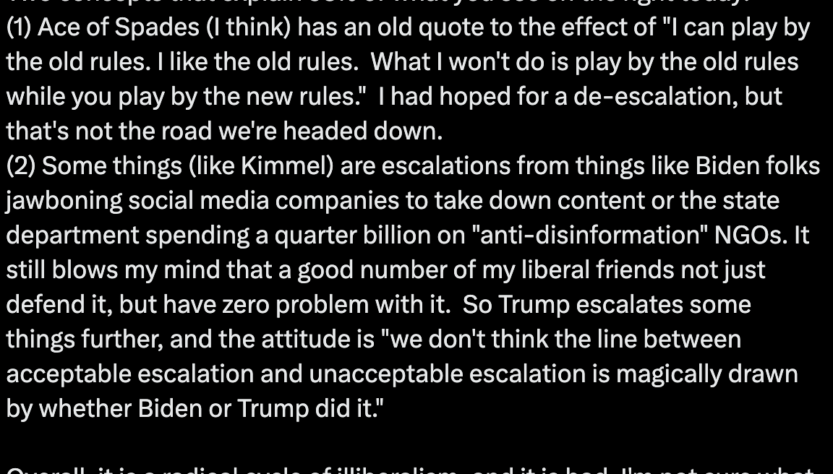
In the wake of Jimmy Kimmel’s suspension, many have taken full advantage of the freedom to spread misinformation about the Constitution online. But, as people with real live law degrees, we’re here to inform you that, no, the FCC threatening to take away broadcast licenses because they don’t like comedians joking about Republicans is not a natural extension of Murthy v. Missouri — the Supreme Court case establishing that the government can, in fact, have a conversation with Facebook during a deadly pandemic to say posts about “injecting yourself with Lysol” is bad advice.
And yet, here we are:

Calling this “a radical cycle of illiberalism” is like calling The Bear a comedy — a disingenuous claim made for self-serving purposes. In reality, the gulf between the situation in Murthy and Kimmel’s firing could scarcely be wider. One was non-coercive and the other was explicitly coercive. THANK YOU FOR YOUR ATTENTION TO THIS MATTER!
Murthy grew out of the slip-shod sensationalization of “The Twitter Files,” a series of internal Twitter documents scrounged up by Elon Musk after acquiring the company and spun into a conspiracy theory that shadowy actors within the federal government routinely coerced social media platforms to censor content. Specifically, law enforcement sharing their findings about election fraud and health agencies discussing potentially dangerous COVID misinformation. Based on these conversations, social media companies might adjust their practices to downgrade conspiracy theories… or might not! That’s going to be a key fact later.
This Musk-peddled tale inspired a judge-shopped challenge from some state AGs looking for a path to higher office, that ultimately died in front of the Supreme Court.
Justice Barrett, writing for a 6-3 majority, explained that an actual claim of government censorship — even indirect, “jawboning” censorship — requires the plaintiffs to show “a substantial risk that, in the near future, they will suffer an injury traceable to a Government defendant.” That… simply did not exist. [UPDATE: Especially not for the state AGs — who had no standing at all]
No one in the government ordered Facebook to delete posts. The government shared information at its disposal and the tech companies were free to do with that whatever they wanted. They might choose to provide an editorial note to add proper context to that medical advice from your 8th grade dropout cousin, but if they did so, it was because they decided to protect their customers, not because the government threatened to do anything if they didn’t. Yes, there were some very dumb tantrums from legislators, but they went nowhere and, more to the point, had nothing to do with the conversations actually taking place between the government and social media platforms.
Contrast with the Kimmel situation. Trump began threatening to ask the FCC — majority staffed by Republicans and chaired by Project 2025 contributor Brendan Carr — to revoke broadcast licenses over content critical of his regime back in February. This elevates the urgency of any actual FCC threat. After Kimmel’s monologue, Carr appeared on a right-wing podcast and said that his agency has “remedies we can look at” and that “these companies can find ways to change conduct and take action, frankly, on Kimmel or there’s going to be additional work for the FCC ahead.” He added, “we can do this the easy way or the hard way.”
This is square in the middle of the standard set out by the Supreme Court: “a substantial risk that, in the near future, they will suffer an injury traceable to a Government defendant.” Following his remarks, two conglomerates owning local affiliates pressured ABC to drop Kimmel. Of note, the FCC can’t actually “take away ABC’s license,” but rather take away the licenses of affiliate broadcasters. “And if there’s local TV stations that don’t think that running that programming does it, then they have every right under the law in their contracts to preempt it,” Carr said. “And we’ll see how this plays out.”
Thus, Carr’s threat was directed at the affiliates and that in turn prompted the response. One of those conglomerates, Nexstar is currently trying to get FCC approval to buy more affiliates in breach of rules designed to prevent media consolidation. The other, Sinclair, is basically a conservative channel cartel that has flexed its power to make its channels parrot right-wing scripts, misleadingly passed off as coming independently from local reporters.
Speaking of misleading, that’s what Carr claimed Kimmel had done: “It was appearing to directly mislead the American public about a significant fact that probably one of the most significant political events we’ve had in a long time, for the most significant political assassination we’ve seen in a long time,” Carr said. This, by the way, is a lie that’s also taken on a life of its own.
Even some liberals defending Kimmel have adopted the frame that Kimmel’s comments were inaccurate, but they were not. Not that it would matter constitutionally if he were wrong, but there’s no need to cede this point designed to give the firing some kind of moral, if not legal, justification. You’ll see a lot of commentary about how Kimmel “said the shooter was MAGA” or something of that ilk, but what he actually said was that conservatives spent the weekend desperately trying to prove that the shooter wasn’t a right-wing radical. Which is true! As more evidence leaked out about Pepe the Frog poses and Groyper flirtations, the incomplete image of the shooter tilted toward a far-right actor and Republicans on social media scrambled to push back or downplay everything coming out.
Here it is, if you didn’t actually see it:
The proper comparison with Murthy would be the DOJ telling ABC, “just so you know, we now have evidence that the shooter’s politics veered left over the last several months… you’re free to do with that information whatever you want.” Instead, as FCC Commissioner Anna Gomez explained, “This Administration is increasingly using the weight of government power to suppress lawful expression… not because speech glorifies violence or breaks the law, but because it challenges those in power or reflects views they oppose.”
The point is that there is no through line from Murthy to this. It’s an apples and koalas comparison. Anyone out there suggesting there’s some logical extension from the government sharing public health intel with social media platforms and threatening to take away broadcast licenses because it hurts Republican feelings is, to use the technical legal term, a fucking idiot. As lawyers, we have a public duty to push back on this nonsense trope wherever it crops up — because we don’t need to cancel free speech here, we just need to deploy our legal acumen.
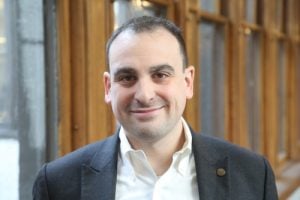 Joe Patrice is a senior editor at Above the Law and co-host of Thinking Like A Lawyer. Feel free to email any tips, questions, or comments. Follow him on Twitter or Bluesky if you’re interested in law, politics, and a healthy dose of college sports news. Joe also serves as a Managing Director at RPN Executive Search.
The post Stop Saying The Supreme Court’s ‘Twitter Files’ Decision And The Kimmel Suspension Are The Same appeared first on Above the Law.
